My brother-in-law texted me a voice note in March 2026, approximately forty-eight hours after he’d put down $1,299 on a Galaxy S26 Ultra. The message was four minutes long. It covered, in order: how fast the camera opens, how the S Pen feels on the new display, his concern that the aluminum frame feels cheaper than the titanium on last year’s S25 Ultra, and whether he should have waited for the iPhone 18 Pro instead. He hadn’t even used the phone for two full days and the buyer’s remorse was already circling. I hear some version of this story every single year, every single smartphone season. The “did I buy the wrong one” panic is a rite of passage for anyone spending over a thousand dollars on a phone.
So let’s actually answer the question before you spend the money — not with a spec-sheet comparison, but with the stuff that actually determines whether you’ll be happy with a phone six months after you bought it.
The Quick Reality Check: What These Phones Actually Cost
The Galaxy S26 Ultra carries a starting price of $1,299 for the base 256GB model, announced at Galaxy Unpacked on February 25, 2026, and available in stores from March 11. The 512GB version runs $1,500 and the 1TB tops out at $1,800.
The iPhone 17 Pro starts at $1,099 for 256GB — that’s $200 less than the S26 Ultra at base storage. The 512GB version is $1,299 and the 1TB is $1,499.
So at every storage tier, the iPhone 17 Pro is $200–$300 cheaper than the S26 Ultra. That’s not a small gap. If budget is genuinely a factor in your decision, that gap matters — and I’d push back on anyone who waves it away as “it’s only $200 more.” Over a two-year ownership cycle, $200 is $200.
Design: One Got Lighter, One Got Smaller
The Galaxy S26 Ultra is 7.9mm thick and weighs 214 grams — 0.7mm thinner and 18 grams lighter than the Galaxy S24 Ultra, which translates to noticeably better one-hand usability during extended sessions. Samsung has returned to aluminum for the frame after two generations with titanium on the S24 Ultra and S25 Ultra — a quiet but notable material shift that has divided opinion.
Honestly, the aluminum frame thing is worth paying attention to if you’re upgrading from an S25 Ultra. In the hand, the difference between aluminum and titanium is real — titanium has a premium, slightly warmer feel that aluminum doesn’t fully replicate. It’s not a dealbreaker, but if you’re holding both and paying $1,299, you notice.
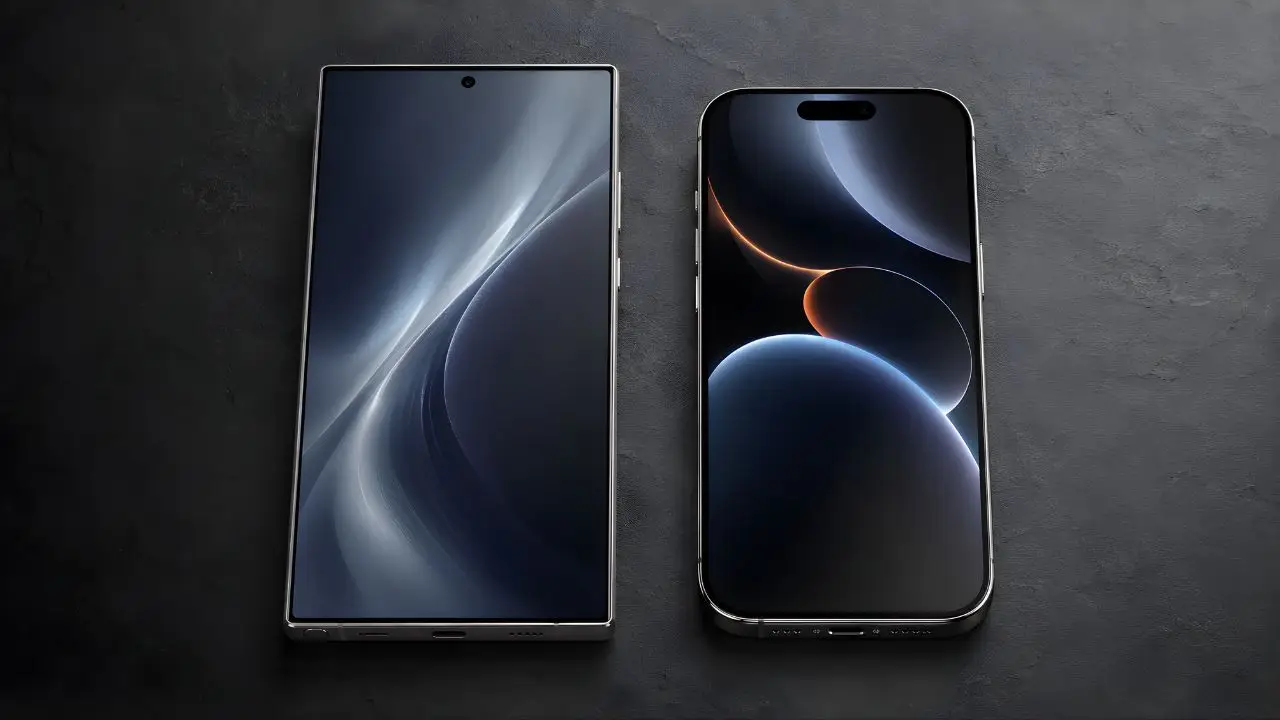
The iPhone 17 Pro makes a bigger visual statement with its shift to an aluminum unibody chassis — replacing the titanium frame from the iPhone 16 Pro — paired with a vapor chamber for improved heat dissipation under load. It measures 150.0 x 71.9 x 8.75mm and weighs 206 grams. The iPhone 17 Pro is meaningfully more compact than the S26 Ultra — a 6.3-inch phone versus a 6.9-inch phone — and that size difference is the first real fork in the road. If you want a big screen, you’re leaning Samsung. If you want something pocketable and one-hand manageable, the iPhone wins this round without argument.
Display: Both Are Excellent — Here’s What’s Actually Different
The S26 Ultra runs a 6.9-inch Dynamic AMOLED 2X panel at QHD+ resolution (3,120 × 1,440 pixels), with LTPO adaptive refresh from 1Hz to 120Hz and HDR10+ support, protected by Corning Gorilla Armor 2. Samsung’s headline display addition for 2026 is the Privacy Display — a world-first feature that limits viewing angles on demand, so people beside you on the train or in a coffee shop can’t see your screen. That’s genuinely useful for anyone who works on sensitive documents in public and it’s a feature the iPhone 17 Pro simply doesn’t have.
The iPhone 17 Pro sports a 6.3-inch Super Retina XDR OLED panel at 2622 x 1206 pixels, peaking at 3,000 nits, with the same 1–120Hz ProMotion adaptive refresh rate. The pixel density is slightly higher on the iPhone at 458 PPI versus the S26 Ultra’s 503 PPI, but both are well past the threshold where the human eye stops distinguishing individual pixels at normal viewing distances. In real use, both displays look stunning. The S26 Ultra wins on raw size and the Privacy Display feature. The iPhone 17 Pro wins on compactness and one-hand comfort.
Camera: The Spec Gap Is Real, But Not the Full Story
This is the section most people read first and I want to be careful here, because specs and real-world results diverge more on cameras than anywhere else in phone comparisons.
Samsung Galaxy S26 Ultra Camera
The S26 Ultra’s 200MP main camera features a wider F1.4 aperture — a meaningful upgrade that lets in more light, particularly in nighttime and low-light shooting scenarios. Samsung introduced the new Camera Island design language — a unified, integrated camera module — which gives the Ultra a more cohesive architectural appearance compared to the angular camera array of the S24 Ultra. The system includes a 12MP ultrawide and a 50MP 5x periscope telephoto, plus a 10MP 3x optical zoom lens. Four camera lenses in total.
The 200MP sensor sounds extraordinary on paper. In my experience, what it actually does in practice is give you exceptional flexibility to crop aggressively in post without losing detail — you can take a 200MP shot and crop to 50MP and still have a high-resolution image. For photographers who like to reframe shots after capture, that’s genuinely valuable. The F1.4 aperture on the main sensor is the more immediately useful upgrade for everyday shooting though — low-light shots show a visible improvement over the S25 Ultra.
iPhone 17 Pro Camera
The iPhone 17 Pro has a 48-megapixel triple-lens camera system featuring a new telephoto lens with up to 8x zoom. The telephoto now sits at 4x optical zoom using a larger 48MP sensor — previously 5x at 12MP — and the selfie camera has jumped to 18MP with wide-angle capability, able to capture landscape selfies with the phone held vertically.
The thing nobody tells you about iPhone cameras is how much of the quality comes from Apple’s image processing pipeline rather than the raw sensor specs. Apple’s Photonic Engine, Deep Fusion processing, and computational photography stack produce images that look immediately ready to share without editing — consistent color, controlled highlights, natural skin tones. Samsung’s processing has gotten significantly better since 2023, but Apple’s out-of-the-box image quality still wins for people who don’t edit their photos before posting. If you shoot RAW and process in Lightroom, the gap narrows considerably and becomes more about personal preference.
Both phones shoot ProRes video. Both do 4K at up to 120fps. Both have excellent night modes. For video work specifically — and this surprises people — the iPhone 17 Pro’s log video format and color science integration with professional editing tools on a Mac is still meaningfully smoother than Samsung’s equivalent workflow… you get the idea if you’ve ever tried to grade S-Log footage from a Galaxy in Final Cut Pro.
Performance: Both Are Fast. Here’s the Real Difference
The S26 Ultra runs the Snapdragon 8 Elite Gen 5 for Galaxy — the fastest Snapdragon chip yet, with Samsung’s customization layer on top for improved NPU performance on Galaxy AI tasks. The iPhone 17 Pro carries Apple’s A19 Pro chip, built on a 3nm process, with a vapor chamber cooling system specifically designed to let it run at sustained performance levels without thermal throttling.
Benchmarks show the A19 Pro pulling ahead in sustained performance tests — tasks that run for several minutes under load, like video rendering or machine learning processing — because the vapor chamber keeps it cooler longer. In everyday use, both phones are faster than any task you’ll throw at them. Gaming, multitasking, app switching, loading times — the gap is invisible to real users. The performance difference only shows up in sustained professional workflows, and if that’s your use case, you probably already know which ecosystem you’re in.
Battery Life: Samsung Finally Catches Up
For years, battery life was a reliable iPhone advantage. The iPhone 17 Pro changes that dynamic a bit — Apple describes the iPhone 17 Pro models as featuring the longest battery life of any iPhone to date. The iPhone 17 Pro carries a 7,698mAh battery — a substantial jump — with 40W wired charging and 25W wireless via Qi2.
The S26 Ultra packs a 5,000mAh battery with 60W fast charging. Samsung’s 60W charging is noticeably faster in real use — getting to 50% in about 35 minutes versus iPhone’s approximately 50% in 20 minutes claim (though independent tests put iPhone’s real-world 50% time closer to 25–30 minutes). The S26 Ultra also supports 25W wireless charging and 15W reverse wireless charging.
In my experience, both phones comfortably last a full day of heavy use. The iPhone 17 Pro’s battery is a bigger jump year-over-year. Samsung’s charging speed advantage is real if you’re frequently topping up quickly mid-day rather than overnight charging.
Software and AI: Two Very Different Philosophies
The S26 Ultra ships with Android 16 and One UI 8, with Samsung’s Galaxy AI features baked throughout the system — AI-powered note summarization, Circle to Search, Live Translate, Transcript Assist, and the new AI-assisted writing tools. Samsung also integrates Perplexity, Google Gemini, and Bixby as parallel AI options, giving you genuine choice about which AI system handles different tasks.
The iPhone 17 Pro runs iOS 26 with Apple Intelligence — Siri improvements, Writing Tools, Image Playground, and the Clean Up photo editing tool. (iOS 26, for what it’s worth, is Apple’s most visually dramatic update since iOS 7 back in 2013 — the Liquid Glass interface is a significant shift that’s been getting polarized reactions from long-time iPhone users.) Apple Intelligence is more tightly controlled and more privacy-focused than Samsung’s Galaxy AI, but it’s also less expansive in what it can do. Samsung gives you more AI tools. Apple’s AI tools integrate more consistently with the rest of the system.
One unique S26 Ultra advantage: the S Pen. It’s still one of a kind in the smartphone market — a pressure-sensitive stylus built into the phone’s body, useful for note-taking, sketching, and precise selection in photo editing. If you’ve never used it, it’s hard to explain how much it adds to certain workflows. If you know you’d use it, it’s a genuine differentiator. If you know you wouldn’t, ignore it.
Who Should Buy Which Phone — Let Me Be Direct
Buy the Samsung Galaxy S26 Ultra if: you’re an Android user who wants the largest, most feature-packed flagship on the market. You want a 6.9-inch screen for media consumption, the Privacy Display for public use, the S Pen for productivity, and the flexibility of a 200MP camera with four lenses. You also appreciate faster wired charging and the option to choose between multiple AI assistants. At $1,299 starting, you’re paying a premium — but you’re getting a phone that does more distinct things than any other Android on the market.
Buy the iPhone 17 Pro if: you’re in the Apple ecosystem or considering switching into it. You want a more compact phone that fits in a jeans pocket without thinking about it. You value Apple’s image processing consistency, ProRes video integration with Mac editing tools, and the longest iPhone battery life ever shipped. At $1,099, it’s the better value of the two at base storage, and iOS 26’s polish and long-term software support (Apple supports iPhones for 6–7 years versus Samsung’s 4–5 years of guaranteed Android updates) adds real long-term value.
Wait and watch if: you’re on the fence and you’re in the second half of 2026. Apple is launching the iPhone 18 Pro and a foldable iPhone in September 2026. If you can hold out a few months, that launch will either give you a compelling new option or push prices on the current iPhone 17 Pro down by $100–200 through carrier deals.
Quick Specs Comparison
| Feature | Samsung Galaxy S26 Ultra | iPhone 17 Pro |
|---|---|---|
| Starting Price | $1,299 (256GB) | $1,099 (256GB) |
| Display | 6.9″ QHD+ AMOLED, 120Hz | 6.3″ OLED, 120Hz ProMotion |
| Chip | Snapdragon 8 Elite Gen 5 | Apple A19 Pro (3nm) |
| Main Camera | 200MP, F1.4 | 48MP, F1.8 |
| Telephoto | 50MP 5x periscope + 10MP 3x | 48MP 4x (8x digital) |
| Battery | 5,000mAh, 60W wired | 7,698mAh, 40W wired |
| S Pen | ✅ Yes | ❌ No |
| Privacy Display | ✅ Yes | ❌ No |
| OS | Android 16 / One UI 8 | iOS 26 |
| Software Updates | 4–5 years guaranteed | 6–7 years typically |
| Frame Material | Aluminum | Aluminum unibody |
| IP Rating | IP68 | IP68 |
| Weight | 214g | 206g |
| Colors | Black, White, Sky Blue, Cobalt Violet | Silver, Cosmic Orange, Deep Blue |
The Honest Bottom Line
Neither phone is wrong. That’s genuinely the answer. The Galaxy S26 Ultra is the better phone for someone who wants Android, a massive screen, the S Pen, and the most feature-dense flagship Samsung has ever shipped. The iPhone 17 Pro is the better phone for someone in the Apple ecosystem, who values compactness, long-term software support, and the most consistent camera experience in the smartphone market.
The mistake most people make — and my brother-in-law made it too — is buying one hoping it’ll feel like the other. It won’t. These two phones represent genuinely different philosophies about what a smartphone should prioritize, and whichever one aligns with how you actually use your phone is the right answer. Simple as that.
So here’s my question for you: are you currently on Android or iPhone, and is this comparison making you want to switch — or stick where you are? Drop it in the comments. I’m genuinely curious how many people are considering jumping ecosystems versus just upgrading within the one they’re already in.